Our Film Opening

Wednesday, 29 March 2017

Evaluation Post 3: What kind of media institution might distribute your media product and why?

Our production company was a London based company called Hammer Productions, an institution known for producing dark films - particularly horror/thrillers similar to our film.


Our distribution company was a global, horizontally and vertically integrated institution - Warner Bros. They are known for thrillers e.g. Inception, The Dark Knight, The Shining and therefore our film would be ideal for them to buy the rights to and distribute as it is the same genre and therefore targets an audience which is already targeted by Warner Bros. A big advantage of working with such a big institution is that they have global reach and appeal and therefore will allow our film to be seen by as large an audience as possible thus maximising commercial success.

This is an extract from the official Warner Bros website showing their global status and integrated nature.
Having looked at similar indie films and other films distributed by Warner Bros we have decided to incorporate both traditional methods and social media into our marketing campaign to effectively reach and appeal to our target audience. We also took inspiration from other films distributed by Warner Bros when designing our release plan.

Evaluation Post 4: Who would be the audience for your media product?

There are a number of audiences for our film. The primary audience is all horror or thriller fans - regardless of gender. Below is an emaze detailing our various audiences:

Powered by emaze

Evaluation Post 5: How did you attract/address your audience?

We addressed and attracted our audience by considering the uses and gratifications theory and meeting the audience's needs, and also through conforming to genre conventions with appropriate themes and characters. Please find below a mind map explaining this in more detail.

Please click present mode in the top right of the mind map for easier navigation.

Audience Feedback

In total I interviewed 8 people - 4 boys, 4 girls - in order to get feedback on our film opening and judge how successful we were off of that. Below are two interviews that I recorded so as to show you the interview process.


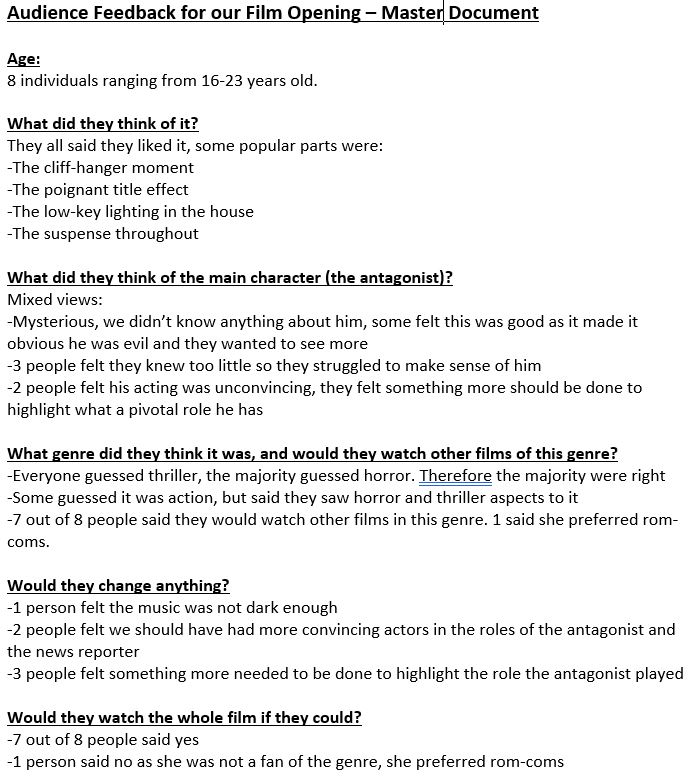
The individuals in these videos were all 16 or 17, and therefore represented one end of our target audience age group of 16-24 year olds. On top of this I also interviewed 2 males and 2 females who were all 21-23 years old so as to collect feedback from the other end of the spectrum. As you can see below, I have collated all the feedback we received into one document.


In conclusion, it seems we were very successful as the majority of the target audience sample said they would watch the entire film, therefore we have clearly met their needs. People particularly enjoyed the suspenseful atmosphere created by the music, the cliff-hanger and the low-key lighting and for the most part were able to directly link this to the horror/thriller genre. This is likely to be because we conformed to genre conventions so the audience could easily identify the genre, thus reinforcing the importance of us following genre conventions and also gratifying the audience's needs for escapism and entertainment as they can easily immerse themselves. Additionally, the consensus seemed to be that people had a lot of questions about what they watched that they wanted to ask, this gratifies their need for social interaction as they will likely discuss this with their friends.

There were some issues that some people highlighted such as unconvincing acting, however it was always a minority and it never seemed to drastically affect their enjoyment. Despite this, I do agree that particular actors were unconvincing and perhaps in the future we would be more thorough and selective with our casting choices. Thankfully, it seemed that those in our target audience sample who raised this point still felt that their need for entertainment had been gratified and therefore we were clearly successful in addressing and attracting the audience.

From a personal point of view, although no one raised this I felt in hindsight that 'Jean Smith' was not an appropriate or classic name for a young, British Muslim. This could potentially limit the appeal to the Muslim demographic as they may find it harder to identify with this character and so 'Jean Smith' may not gratify their needs for identifying with characters. In hindsight, I would do more research into potential character names and choose one more fitting of a young, British Muslim woman.

Evaluation Post 6: What have you learnt about technologies from the process of constructing this product?

Throughout this project, I have not only developed my already existing knowledge of technologies I've previously used but I've also learnt about new technologies and through practice become confident with these too. In order to explore my learning curve with regards to technology, I have created a prezi which can be seen below:

Evaluation Post 7: Looking back at your preliminary task, what do you feel you have learnt in the progression from it to the full product?

My knowledge and skills from both shooting and editing standpoints have improved massively since the preliminary task and this is shown by the improved quality of my work in the full product when compared to the prelim.

Comparison of the Briefs:

Prelim Brief: Create a short continuity sequence in which a character opens a door, crosses a room and sits down opposite another character where they then exchange a couple lines of dialogue. Include match on action, shot/reverse/shot and the 180° rule.

Main Brief: Produce a 2 minute opening sequence for a fiction film with a clear sense of who the target audience is. Include titles throughout, a copyright-free soundtrack and sound effects, some form of continuity and display clear genre conventions through character, theme, story, action, mise-en-scene, dialogue, sound, camera, editing, style etc.

As you can see the main brief was much more intensive and difficult than the prelim brief, however I still felt that I performed better in the main task as the prelim prepared me quite well. From the prelim I learnt several lessons with regards to how I should approach the main task and this helped me improve the quality of my work. For example, from a shooting standpoint I learnt to always film the whole movement to avoid continuity errors, and also to film a master shot as a back up option in case there is a continuity error. From an editing standpoint I learnt to always rename your shots first as it makes the rest of the editing process much faster and much more efficient.

Pre-Production:

The table below shows the differences in the planning process.


For the main brief we went into much more detail with the planning and did much more intensive research as from the prelim we learnt that a lack of planning leads to a lot of wasted time later on as your are unsure of what to do. Additionally, the prelim planning process gave us experience in the planning stage so we knew where to improve when it came to the main task.

Production:

The basic principles were the same across both tasks, for example we followed the same continuity rules. However, the production for each was very different as we were able to experiment a lot more, for example we experimented with shaky handheld shots in the main task whereas we weren't able to in the prelim.

Similarity Example:


This displays the continuity rule of match on action in the prelim


This displays the continuity rule of match on action in the main task

The match on action was much smoother in the main task than in the prelim as I felt in the prelim there was a slight jump cut which we were able to avoid in the main task.

Difference Example:


Taken from the main task

In the main task we had more freedom and time to experiment with different types of shots that we were unable to try out in the prelim. Above is an example of a shaky handheld shot which worked very well in our main task but we were unable to experiment with in the prelim. This was a very tricky shot, however because we had much more time we were able to shoot a lot more takes until we had one we were happy with.

Post Production:

We used the same software for editing in both projects but in the main task we were able to take advantage of more editing tools in Adobe Premiere than in the prelim. For example, I learnt how to use a key-frame zoom, how to implement special effects and how to grade our shots.


A keyframe zoom from the main task


An example of where I implemented special effects

In terms of what the prelim taught us for editing there were three key learning points:

1) Always name your shots as it saves time later on when you're looking for the shot you wish to work with.
2) Before doing any advanced editing e.g. special effects/grading, have all your shots roughly cut down and in the timeline.
3) When placing shots in the timeline place them on alternate tracks so that everything is easier to move, edit and you avoid messing with the wrong shot.

In conclusion, the progression from the preliminary task to the full product has seen a huge increase in my technical ability with both the shooting equipment and editing software. Compared to when we did the prelim task I feel much more confident in my ability to produce a quality media product and am proud of not only myself, but also my group as we have all improved together.

Monday, 20 March 2017

Construction Post 30: Looking back - reflections on our final outcome

My group and I have recorded a podcast in which we talk about our final media product and what we think of the final outcome. I have uploaded it to SoundCloud and you can access it below:

Sunday, 19 March 2017

Construction Post 29: My Technical Learning Curve

This project has taught me so much from multiple standpoints, from a shooting standpoint, an editing standpoint and an organisational standpoint. I have certainly learnt a lot in this project and have become more technically able in media studies.

Whilst I have shot before, I have never shot a handheld shot and in this way the production phase was a huge learning experience for me. It was challenging as you don't have a spirit level to tell you if the shot is canted or not like you do when using a tripod. Therefore, you have to make a conscious effort to keep the camera straight and it certainly took me multiple attempts before I achieved this.

Above is footage of me shooting a handheld shot. As you can see it was very important for me to stay as still and steady as possible

With regards to shooting, I certainly learnt a lot more technical factors to be aware of when shooting. For example, with every shot we had to consider continuity and make sure we weren't going to break any rules and cause a jump cut for example. This required me to engage even more with the production process and certainly taught me a lot with regards to production in the media industry.

I already had previous experience with our editing software - Adobe Premiere Pro - however I learnt much more this time round and felt like I certainly made much better use of the tools available to me in this programme when compared to previous experiences. For example, I learnt how to zoom in on specific parts of shots in editing using key frames whereas previously I would have simply zoomed in when shooting which would have been much more unprofessional. I also learnt how to effectively use and edit visual FX and I enjoyed this learning process a lot. As a result, I now feel much more confident when editing.


Above is an example of a key-frame zoom. As you can imagine this looked much more professional than it would have if we were to zoom in when shooting.

In terms of skills that aren't necessarily exclusive to media, this project has greatly improved my organisation. This is because in order to consistently work efficiently my organisation always had to be good. This is because there are so many factors that need organising for the project to run smoothly, for example I had to help organise actors, their timings, costumes and locations and frequently remind them. This requires high organisational skills and mine have certainly improved as a result.